It is mid March and winter has begun to give way to spring. Gardeners are planning what crops to plant. Early crocus erupt bright purple or yellow against the drab coat of winter. Spring is on its way. Beach lovers long for the crash of surf, the spray of salt mist, and the bright rays of sun warming bare shoulders.
As a child, a trip to the beach meant 34th Street in Ocean City, N.J. It meant sand laced bologna and cheese sandwiches on a corner of a sandy blanket. After hours of riding waves on rented blue and yellow rafts, those gritty sandwiches were quite tasty. The day ended with one trying to find a comfortable position to sleep that didn't aggravate the sunburned face, back and shoulders.
Years later... many years later, I now spend most days heading for the beach. Living on a boat in the Bahamas gives new meaning to the phrase, hitting the beach. Leaving footprints in the sand, frolicking in the surf, and beach combing continue to a major role in beach usage. But that is only the beginning.
Fellow live a-boards have found many interesting ways to utilize the nearby beaches. Beaches offer nearby land based destinations where one can disembark and stretch the legs. At the height of the season, February through early March nearly 300 boats anchor along the beaches of Elizabeth Harbor in the Exumas. Every day there is another beach event.
Traditional fun volleyball begins at 2:00 p.m. each day. Early morning yoga draws nearly 30 boaters who spread out their towels, stretch, and breathe as water laps softly in the background. Overhead, soft needled casuarina trees sway ever so slightly in a light breeze.
On Thursdays, budding artists learn to watercolor, weave a basket with silver palm or tie decorative knots. The art on the each group brings amateur and professional artists together. Nearby, a group of cruisers play dominos. Others learn the game of bridge. Another day someone might offer a knitting seminar or a session about maximizing solar panel output. One can even learn how to make a conch shell horn.
One morning, a cruiser might announce an open invitation for sundowners on the beach. The rule is to bring a snack to share, boat cards, and a beverage of one's choice. It might not be as formal as a Chamber of Commerce mixer, but it offers boaters a way to meet fellow cruisers and to exchange information. On beaches everywhere, cruisers bring in books and compact discs for swapping. There are sand sculpture events and for the ultimate sand trap, one can even try their skill with beach golf.
At Hog Cay in the Jumentos, sundowners also include a green flash watch that begins as the sun dips into the sea. If visibility is clear and clouds are absent, cheers go up when the green flash blinks as the sun sets below the horizon. That is when conch horns begin to sound. Some evenings cruisers get together on the beach for a impromptu jam session. They bring guitars, banjos, harmonicas and cymbals. Some bring kazoos. Others have brought bagpipes, or violin. One boater played the saw.
When in the out islands, cruisers sometimes cook dinner communally on a fire pit fashioned out of rocks. Each brings food to grill and a covered dish to share. Following dinner the auxiliary fire pit is used for the trash burn. Since there is no place to dispose of garbage, all paper and plastic is burned on the beach. Cans and jars are retained until the boater heads back to civilization.
Boaters who venture to the far southern Bahamas are a creative group and hold events known as Beach Junk Wars and Beach Olympics. The Atlantic Ocean beaches are covered with junk; lumber, bamboo, plastic drums, medical waste, nylon rope, old shoes, bottles, and anything that floats can be found along the high tide line. Hard hats and welding helmets might become wild looking Junkanoo masks. Coconuts and string turn into to bras. Puppets have been made from doll parts washed ashore and wind chimes from bamboo and floating seed pods.
Beach Olympics include kayak racing, swimming, and hermit crab racing. Hermit crabs are scavengers and prove easy to gather with a some dinner scraps on the beach. The nocturnal critters, up to four inches in the shell, have no clue that they will become the next beach Olympic contestant. Numbered with red fingernail polish, the critters are placed in the center of a large circle. The winner is the first one out.
The cruisers at Hog Cay have made a bocce ball court on the san d. Rope tied to an old plastic bread tray found on the beach becomes a zamboni to smooth the sand. Small plastic floats washed ashore become the balls. A small raised molded strip around the diameter of the float allows for one way rolling. Those who forgo bocce ball can fanny dip in the clear shallow water along the shore. Boaters bring a drink and sit together in the cooling water at waist level.
On Valentines Day, the residents of nearby Ragged Island host a party on the beach for the cruisers at Hog Cay. During the event, the boaters hold an action of donated items to benefit the all age school on Ragged Island.
Cruisers walk, jog and hike along the Bahamian beaches. They collect sea glass, sea shells and sea beans. They haul wood from the beach for the fire pit. Sometimes they find neat artifacts. I've found a wooden mortar and pestle. For cruisers a large part of life centers around the beach. It serves as a community center, a classroom, a playing field, watering hole and library. We share stories and make new friends. We celebrate, we console, and we give back. Yes, life is a beach.
March 26, 2013


March 12, 2013
Bush medicine
Cuts, colds, an aching head or back often sends the sufferer scurrying to a nearby drugstore, physician, or in extreme cases to the emergency room of a local hospital. The availability of medical care is not something that most Americans think about in terms of availability. Americans might complain about the outrageous cost of that same care. Nonetheless, it is available.
Traveling in some of the more remote areas of the Bahamas this winter, I've learned that many of the sparsely populated islands don't have a full time doctor. On others, a doctor might fly in once a week or a nurse might be on call. Over time, Bahamians living on some of the more remote and underdeveloped islands acquired an important oral knowledge of herbal lore that would become referred to as bush medicine.
Some of this knowledge came from their African heritage. Many of the same remedies used during the slavery era in Bahamian history are used today. Mary Rolle, a grandmother of two and resident of Nassau, grew up in the settlement of Rolleville on Barratare. She explained that while growing up her parents treated their children's illness with native plants growing on the island.
As a child Rolle suffered from asthma which her mother treated with a plant called Life Leaf. "My mother would beat Life Leaf in a cloth and squeeze out the juice before mixing it with butter and some lemon or lime. She would heat the mixture and give it to me to drink," Rolle continued. "We didn't have doctors or drugstores."
Rolle now lives in Nassau and has forgotten much of the natural pharmacology routinely used by her mother so many years ago. She said that mothers gave their children catnip for worms and white sage for itching . "We used to remove the thorns from the prickly pear and use the meat to wash our hair," Rolle remembered.
Martha Hanna-Smith hails from the settlement of Delectable Bay on Acklins Island. She grew up drinking bush teas and had never heard of Lipton or Earl Gray.
As a young girl, Hanna-Smith took notice that some of the teas she consumed were also used to treat illness. The Fever Grass tea that she drank with breakfast could also be used to bring down a fever. Her fascination with bush medicine grew. She would ultimately author the book Bush Medicine in Bahamian Folk Tradition, published in 2005.
In the book Hanna-Smith tells how her father insisted that his children drink a bitter draught consisting of a half cup of warm water with a few drops of juice from the Aloe plant each morning.
Historically, Aloe has been used in the home for cuts and burns. The healing plant can also be found in many lotions and salves around the house. Traditional Bahamian bush medicine also uses the plant as a tea to increase appetite, move bowels, help with indigestion and to fight colds. According to bush medicine practices, heating and applying the gel like juice will help with infected cuts and the pain of sprains.
Hanna-Smith's book lists plants for backache, blisters, blood pressure control, colds, constipation, coughs, diabetes, fever, flu, headaches, and hangovers. Native Bahamian flora has been used to treat hiccups, heartburn, rashes as well as the childhood illness of measles, mumps and chicken pox. Thistle, Papaya, Scourge Needle and Mistletoe are offered as a cure for ringworm .
For increased male virility, Bahamians have relied on teas of Love Vine, Five Fingers, Gum Elemi, Striping Back, Sweet Margaret and Wild Pine. One formula instructs the practitioner to gather all the the above ingredients, boil together and strain, add sugar to taste, some brandy, and evaporated milk. The brew is then poured into a bottle and steeped for about three weeks. Once imbibed, it is said to build energy in a man.
Locals on Ragged Island say that the Love Vine lives up to its name. It is said to prevent sexual weakness. Bahamians beat the parasitic stringy yellow orange vine and boil it into a strong tea. A bus driver on Grand Bahama Island, who wished to remain nameless, swears by this remedy. It seems like a lot of work, but is probably cheaper that the famous purple pill. Perhaps the pharmaceutical companies are already researching this bush medicine remedy?
One drawback of bush medicine is that the names of plants can vary from island to island. Hanna-Smith explains in her book that Buttercup is known as Miss William in San Salvador and Three Days Bush on Acklins. Portions can also vary as a handful of leaves to one could be quite a bit different from one person to another.
For nearly 500 years, bush medicine from an Amerindian and African heritage, played an important role in Bahamian history. It is a tradition that is fading away as barriers to modern medicine on many of the remote family islands have been removed.
Nassau, on New Providence Island, offers a state of the art modern medical facility that serves the entire Bahamas. Soon a second hospital, now under construction, will open in Georgetown, Great Exuma. The new hospital will serve the southern Bahamas, making a shorter trip for those who need treatment for a full spectrum of illness. Currently, emergencies from the Out Islands are taken by plane or boat to Nassau to the modern medical facility there.
At one time the quality of life for Bahamians depended on bush medicine. Pharmaceutical companies around the globe now research some of that knowledge. Wouldn't it be a miracle if White Sailor's Cap or Snake Root could be synthesized to produce a cure for some types of cancer?
Traveling in some of the more remote areas of the Bahamas this winter, I've learned that many of the sparsely populated islands don't have a full time doctor. On others, a doctor might fly in once a week or a nurse might be on call. Over time, Bahamians living on some of the more remote and underdeveloped islands acquired an important oral knowledge of herbal lore that would become referred to as bush medicine.
Some of this knowledge came from their African heritage. Many of the same remedies used during the slavery era in Bahamian history are used today. Mary Rolle, a grandmother of two and resident of Nassau, grew up in the settlement of Rolleville on Barratare. She explained that while growing up her parents treated their children's illness with native plants growing on the island.
As a child Rolle suffered from asthma which her mother treated with a plant called Life Leaf. "My mother would beat Life Leaf in a cloth and squeeze out the juice before mixing it with butter and some lemon or lime. She would heat the mixture and give it to me to drink," Rolle continued. "We didn't have doctors or drugstores."
Rolle now lives in Nassau and has forgotten much of the natural pharmacology routinely used by her mother so many years ago. She said that mothers gave their children catnip for worms and white sage for itching . "We used to remove the thorns from the prickly pear and use the meat to wash our hair," Rolle remembered.
Martha Hanna-Smith hails from the settlement of Delectable Bay on Acklins Island. She grew up drinking bush teas and had never heard of Lipton or Earl Gray.
As a young girl, Hanna-Smith took notice that some of the teas she consumed were also used to treat illness. The Fever Grass tea that she drank with breakfast could also be used to bring down a fever. Her fascination with bush medicine grew. She would ultimately author the book Bush Medicine in Bahamian Folk Tradition, published in 2005.
In the book Hanna-Smith tells how her father insisted that his children drink a bitter draught consisting of a half cup of warm water with a few drops of juice from the Aloe plant each morning.
Historically, Aloe has been used in the home for cuts and burns. The healing plant can also be found in many lotions and salves around the house. Traditional Bahamian bush medicine also uses the plant as a tea to increase appetite, move bowels, help with indigestion and to fight colds. According to bush medicine practices, heating and applying the gel like juice will help with infected cuts and the pain of sprains.
Hanna-Smith's book lists plants for backache, blisters, blood pressure control, colds, constipation, coughs, diabetes, fever, flu, headaches, and hangovers. Native Bahamian flora has been used to treat hiccups, heartburn, rashes as well as the childhood illness of measles, mumps and chicken pox. Thistle, Papaya, Scourge Needle and Mistletoe are offered as a cure for ringworm .
For increased male virility, Bahamians have relied on teas of Love Vine, Five Fingers, Gum Elemi, Striping Back, Sweet Margaret and Wild Pine. One formula instructs the practitioner to gather all the the above ingredients, boil together and strain, add sugar to taste, some brandy, and evaporated milk. The brew is then poured into a bottle and steeped for about three weeks. Once imbibed, it is said to build energy in a man.
Locals on Ragged Island say that the Love Vine lives up to its name. It is said to prevent sexual weakness. Bahamians beat the parasitic stringy yellow orange vine and boil it into a strong tea. A bus driver on Grand Bahama Island, who wished to remain nameless, swears by this remedy. It seems like a lot of work, but is probably cheaper that the famous purple pill. Perhaps the pharmaceutical companies are already researching this bush medicine remedy?
One drawback of bush medicine is that the names of plants can vary from island to island. Hanna-Smith explains in her book that Buttercup is known as Miss William in San Salvador and Three Days Bush on Acklins. Portions can also vary as a handful of leaves to one could be quite a bit different from one person to another.
For nearly 500 years, bush medicine from an Amerindian and African heritage, played an important role in Bahamian history. It is a tradition that is fading away as barriers to modern medicine on many of the remote family islands have been removed.
Nassau, on New Providence Island, offers a state of the art modern medical facility that serves the entire Bahamas. Soon a second hospital, now under construction, will open in Georgetown, Great Exuma. The new hospital will serve the southern Bahamas, making a shorter trip for those who need treatment for a full spectrum of illness. Currently, emergencies from the Out Islands are taken by plane or boat to Nassau to the modern medical facility there.
At one time the quality of life for Bahamians depended on bush medicine. Pharmaceutical companies around the globe now research some of that knowledge. Wouldn't it be a miracle if White Sailor's Cap or Snake Root could be synthesized to produce a cure for some types of cancer?
February 19, 2013
Rogue dog
It was sometime around noon when the small brown dog went overboard. No one will ever know whether he jumped off the boat to follow his owner Captain Mike, who was in the dinghy, heading towards town to do some shopping. Perhaps the excited pooch lost its footing as it trotted back and forth along the deck excitedly barking at a couple of bottle nose dolphins that swim in the harbor. This day there would be no witnesses to solve the mystery.
Bandit, the wayward pup, would not be able to climb back onto the boat. It wasn't a good day for pup, or human, to go swimming in the beautiful aquamarine waters of Elizabeth Harbor, Great Exuma, Bahamas. North East winds blew a steady 22-knots, with higher gusts, as ominous gray clouds raced across the sky. Boats, even a couple of hundred yards from the lee shore, bobbed up and down in the anchorages. White caps skipped across the top of the two-foot chop in the middle of the harbor. Dinghies swayed back and forth attached to the back of the anchored boats. Not many cruisers would venture out. It was a good day to work inside the boat, read a book, or watch a movie.
The pup's floating home just happened to be named, Rogue Dog. It was a small trawler with blue trim. On this dismal day, the boat was anchored near town on the windward side of the harbor, not affording much protection from the weather. Boaters who can't wait for the wind to die down often take the big boat across the one-and-a-half-mile wide harbor if it is necessary to get groceries, propane, water, gasoline, or Internet service. While there is little protection from North to South winds, it does provide a short, wet and bouncy, dinghy ride into town.
Finishing business in town, the captain of Rogue Dog approached his winter home. Nearing the big boat he became alarmed when his faithful 20-lb cairn terrier did not come to greet him. The alarm quickly became a feeling of dread for the elderly captain as calls for his precious four legged friend went unanswered.
When the first call for help came through the VHF radios across the harbor, it was hard to understand the frantic man's plea for assistance. "Can someone help? My small brown dog went overboard within the last two hours. Can someone help me search? Maybe he made it to shore?"the anguished man pleaded. The broken voice of Captain Mike repeated the call, explaining that he had a dinghy but his vision was poor and he would need someone to look for the dog along the shore.
Several boaters answered the call. The captains of Anania and Water Witch boarded their dinghies for the treacherous wet and lumpy ride across the harbor. One boater suggested that Captain Mike determine a search area by dropping something overboard and watch the direction that wind and waves carried the item. After a few minutes several other brave cruisers began the long trip across the bumpy harbor to aid in the search.
Those of us who could not assist sent out thoughts and prayers for a positive outcome. After a couple of hours, dinghies began the roughest part of the trip back to their boats. The VHF radio squawked with inquiries about the dog. The early news was not good, but boaters were hopeful that the small dog might have been carried down island and made landfall without getting slammed against the jagged iron rock shore line.
Captain Tom from Anania rode with Bandit's elderly master along the shoreline and cays. On a last trip, a long shot and an upwind leg, the elderly man,who could not see well, heard a weak but familiar bark. As the two men in the dinghy neared the deserted shrub covered cay, Captain Tom spotted the wet and tired dog.
Against all odds the rouge dog had paddled against the wind and the waves and made it to the small cay a half mile North and East of where his misadventure began. No one ever dreamed that the dog would have paddled against the waves. It was only a fluke that the two rescuers decided to make the pass upwind of Rogue Dog.
Needless to say, there weren't many dry eyes on Imagine, when at 6:00 p.m., Captain Mike announced on the VHF that Bandit was safe at home, albeit a little wet and tired. With relief and joy in his voice, he thanked all the cruisers who participated in the search and invited them to his boat when the weather cleared to meet his pup and to share a drink.
No sooner had Captain Mike finished when the clicking began. Across the harbor boaters were clicking the talk button on their VHF microphones. That's a boaters way of saying, good job! As the sun set all was well in Elizabeth Harbor. I'm betting that one small brown rogue dog was getting some extra loving that night.
It never ceases to amaze me how cruisers reach out to help other cruisers in need. It is nice to be part of this caring community to know that in an emergency, there are others who come to your aid.
Bandit, the wayward pup, would not be able to climb back onto the boat. It wasn't a good day for pup, or human, to go swimming in the beautiful aquamarine waters of Elizabeth Harbor, Great Exuma, Bahamas. North East winds blew a steady 22-knots, with higher gusts, as ominous gray clouds raced across the sky. Boats, even a couple of hundred yards from the lee shore, bobbed up and down in the anchorages. White caps skipped across the top of the two-foot chop in the middle of the harbor. Dinghies swayed back and forth attached to the back of the anchored boats. Not many cruisers would venture out. It was a good day to work inside the boat, read a book, or watch a movie.
The pup's floating home just happened to be named, Rogue Dog. It was a small trawler with blue trim. On this dismal day, the boat was anchored near town on the windward side of the harbor, not affording much protection from the weather. Boaters who can't wait for the wind to die down often take the big boat across the one-and-a-half-mile wide harbor if it is necessary to get groceries, propane, water, gasoline, or Internet service. While there is little protection from North to South winds, it does provide a short, wet and bouncy, dinghy ride into town.
Finishing business in town, the captain of Rogue Dog approached his winter home. Nearing the big boat he became alarmed when his faithful 20-lb cairn terrier did not come to greet him. The alarm quickly became a feeling of dread for the elderly captain as calls for his precious four legged friend went unanswered.
When the first call for help came through the VHF radios across the harbor, it was hard to understand the frantic man's plea for assistance. "Can someone help? My small brown dog went overboard within the last two hours. Can someone help me search? Maybe he made it to shore?"the anguished man pleaded. The broken voice of Captain Mike repeated the call, explaining that he had a dinghy but his vision was poor and he would need someone to look for the dog along the shore.
Several boaters answered the call. The captains of Anania and Water Witch boarded their dinghies for the treacherous wet and lumpy ride across the harbor. One boater suggested that Captain Mike determine a search area by dropping something overboard and watch the direction that wind and waves carried the item. After a few minutes several other brave cruisers began the long trip across the bumpy harbor to aid in the search.
Those of us who could not assist sent out thoughts and prayers for a positive outcome. After a couple of hours, dinghies began the roughest part of the trip back to their boats. The VHF radio squawked with inquiries about the dog. The early news was not good, but boaters were hopeful that the small dog might have been carried down island and made landfall without getting slammed against the jagged iron rock shore line.
Captain Tom from Anania rode with Bandit's elderly master along the shoreline and cays. On a last trip, a long shot and an upwind leg, the elderly man,who could not see well, heard a weak but familiar bark. As the two men in the dinghy neared the deserted shrub covered cay, Captain Tom spotted the wet and tired dog.
Against all odds the rouge dog had paddled against the wind and the waves and made it to the small cay a half mile North and East of where his misadventure began. No one ever dreamed that the dog would have paddled against the waves. It was only a fluke that the two rescuers decided to make the pass upwind of Rogue Dog.
Needless to say, there weren't many dry eyes on Imagine, when at 6:00 p.m., Captain Mike announced on the VHF that Bandit was safe at home, albeit a little wet and tired. With relief and joy in his voice, he thanked all the cruisers who participated in the search and invited them to his boat when the weather cleared to meet his pup and to share a drink.
No sooner had Captain Mike finished when the clicking began. Across the harbor boaters were clicking the talk button on their VHF microphones. That's a boaters way of saying, good job! As the sun set all was well in Elizabeth Harbor. I'm betting that one small brown rogue dog was getting some extra loving that night.
It never ceases to amaze me how cruisers reach out to help other cruisers in need. It is nice to be part of this caring community to know that in an emergency, there are others who come to your aid.
January 3, 2013
Timing is Everything
 |
| Barry Ellis of Little Farmers Cay |
After three days of rest at Grand Bahama Island, it was time to move south and east to the more southern islands of the Bahamas That is where we will spend the winter. Of course, the wind was blowing from that same direction which would mean that once again, at best Imagine would be a motor sailer, or worse... a trawler with a mast. We could stay and pray for the wind to change, or we could go. What the heck, another 24 hours of beating into the wind and we would reach the Exumas.
Exiting Bell Channel, the VHF radio surprised us with a familiar voice. It was long time Canadian boating acquaintances Brian and Yvonne Wilkins on the catamaran Options III. They were arriving in Lucaya after crossing over from Lake Worth, Fla. the night before. Traveling with them were other sailing friends, Bess Wordell and Jim St. Pierre, on the sailboat Destiny. Both boats were only a couple of miles away. We switched to a non- working channel and quickly caught up as Ed set a course for Great Harbor in The Berry Islands chain. Their timing was great, an hour later and we would not have heard them.
Under sunny skies and shouldering against three to four waves, Imagine sailed slightly off course for a more comfortable ride and to keep air in the mainsail. It was necessary to tack left and then right every couple of miles to maintain the course as we sailed towards The Berrys. A glow of light appeared on the western horizon as we approached the island chain after dark. The course kept us well east of the shallow waters surrounding The Berrys. Imagine sailed past Great Harbor and continued southeast towards Rose Island off of New Providence Island and Nassau.
White blips on the radar screen indicated the movement of other boats, their course and speed. Lights on the darkened horizon 12 or more miles out often prove to be one of the many cruise ships that frequent the area. These behemoth ships light up the darkness like bright white neon from miles away as they circle and wait for daylight to head into Freeport or Nassau. I think Cruise ship marketers plan morning arrivals so that guests awake to the clear turquoise waters as they head into port.
Daylight comes and Rose Island diminishes as Imagine now moves towards the shallow Yellow Banks. Coral heads and rocks dot the shallow area and can prove hazardous to unwary boaters. The lowest depth noticed on this trip was seven feet. Once across, the course was set for Norman's Stake that marks the entrance of Norman's Cay anchorage.
Twenty-seven hours after leaving Grand Bahama, Imagine bobbed at anchor in front of a lone palm tree on a sandy islet inside the Norman's Cay anchorage. We were the only boat anchored. We could have been depicted on paradise postcard. Forty days and 1,262 nautical miles after leaving the Sassafras River on the Chesapeake, we arrived in the southern Bahamas. Ed got the watermaker running. We took showers, ate sandwiches and were asleep before dark.
Large stacked gray clouds Sat heavy on the horizon as Imagine got underway the next morning heading further south. After lunch Ed grabs the binoculars when he notices a boat on the far horizon. As Imagine closes the difference it is obvious that someone is waving from the boat. What appears to be a windsock is a T-shirt. The boat is anchored in front of Galliott Cut.
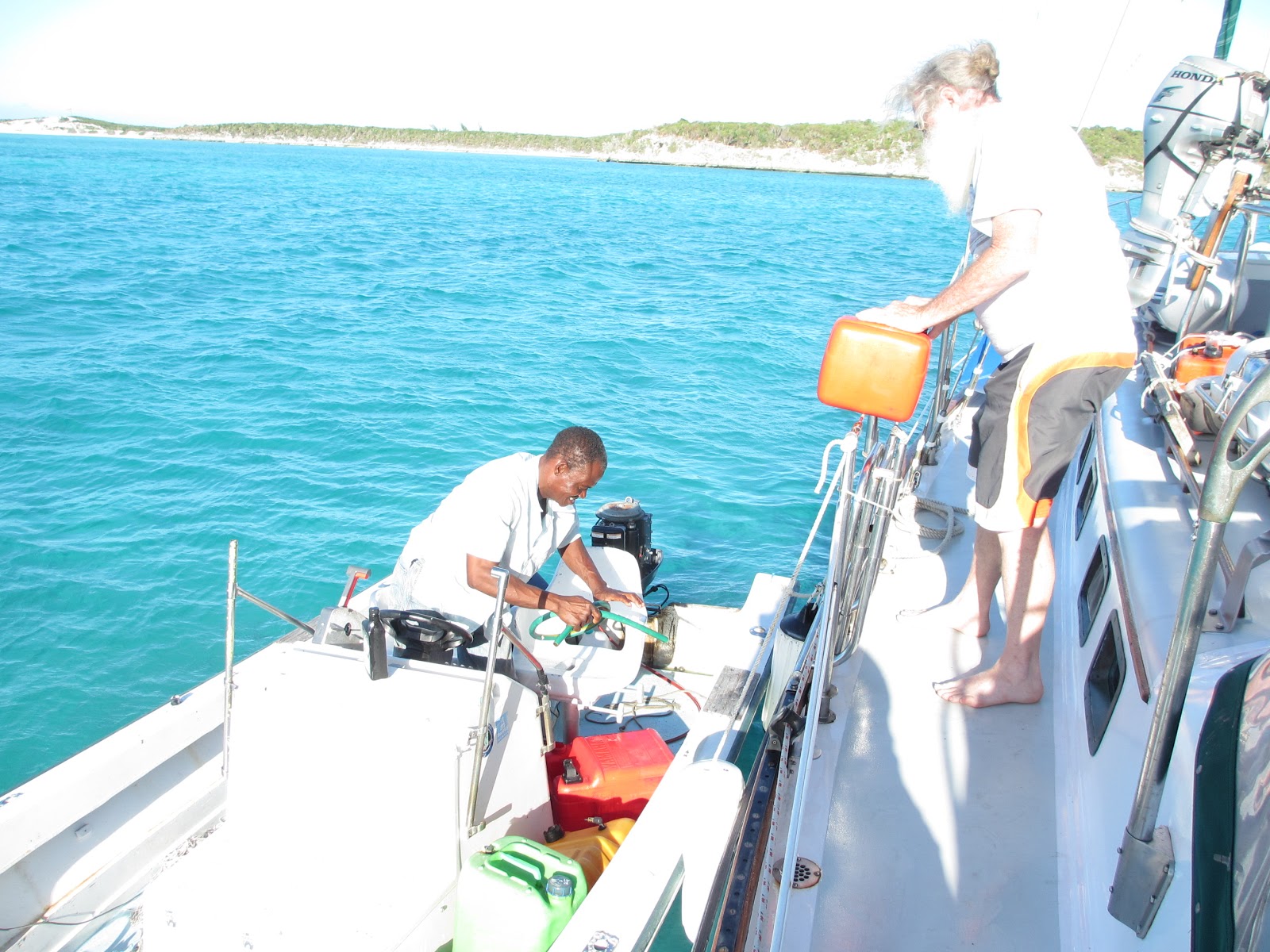 |
| Ed handing gas to Barry Ellis near Cave Cay |
As we get closer we notice the local man waving more frantically. Ed slows Imagine and turns towards the distressed boater. I take a line and go to the bow. The stranded man lifts a red fuel jug to indicate he had run out of gas. He pulls his anchor and I throw him a line.
His name is Barry Ellis and he lives on Little Farmers Cay. He was heading to nearby Cave Cay to get gas and then to Musha Cay (home to magician David Copperfield) to pick his wife up from work when he ran out of gas. The unlucky biater had been sitting there for three hours when came into sight. We towed him as close as we could get to Cave Cay. The low tide kept us from getting all the way in. I anchored Imagine as Ed gave Ellis the gas to get going again. It took a while for the Bahamian to mix oil into the gas and to get his motor started again. When he asked what he owed us, Ed replied, "A simple thank you will do." He told us to stop by Little Farmers for some lobster in appreciation for our help.
After the rescue, Imagine stayed where it was, anchored for the night. The next morning Imagine would snuggle into a no service slip at the Sandals Marina at Emerald Bay to re-fuel and wash six large loads of salty and very smelly laundry. It was a good way to end the day. And as I said in the beginning, timing is everything. I know one Bahamian fisherman who would agree.
Subscribe to:
Posts (Atom)